
Avoid hidden transfer fees and you could save hundreds of dollars every year on your money transfers to Brazil and other countries – but most people don’t even realize they’re being charged these sneaky fees until it’s too late.
I’ve been sending money internationally for over 8 years, and let me tell you, I’ve fallen for every trick in the book. Those “no fee” transfers that cost me $50 in terrible exchange rates? Been there. The surprise $25 correspondent bank fee that appeared days later? Done that too.
Here’s what nobody tells you: Banks and transfer companies have dozens of ways to hide fees from you, and they’re counting on you not knowing about them. But once you learn their tricks, you can avoid hidden transfer fees completely and keep that money where it belongs – in your pocket.
What Are Hidden Transfer Fees (And Why Banks Love Them)
Hidden transfer fees are exactly what they sound like – charges that aren’t clearly disclosed upfront when you send money. Banks love them because they can advertise “low fees” while still making huge profits from your transfers.
Select one of the topics below to access detailed and verified information.
Bolsa Família 2026 Payment CalendarBolsa FamíliaAuxilio Brasil ApplicationThe Most Common Hidden Fees You Need to Watch For
Correspondent Bank Fees: Banks typically charge a fee to initiate a wire transfer. For instance: Bank of America: Domestic: $30; International: $0 in foreign currency and $45 in US dollars, but they don’t always mention the correspondent bank fee – that’s an extra $10-25 that gets deducted somewhere in the middle of your transfer.
Exchange Rate Markups: This is the big one. Your bank might say “no transfer fee!” but then give you an exchange rate that’s 3-6% worse than the real market rate. On a $1,000 transfer to Brazil, that’s $30-60 gone just like that.
Receiving Fees: Some banks charge your recipient to receive the money. Imagine your family in Brazil getting charged R$50 just to accept the money you sent them.
Processing Fees: These pop up for “premium” services like faster processing or weekend transfers.
Payment Method Fees: Using a credit card instead of bank transfer? That’s often an extra 3-4% they don’t mention upfront.
How Banks Make These Fees “Disappear” from Your View
Banks are masters at making fees invisible. Here’s how they do it:
The “No Fee” Scam: They advertise zero transfer fees but mark up the exchange rate by 4-5%. You think you’re getting a deal, but you’re actually paying more than if they just charged an honest fee.
Delayed Disclosure: They show you one set of fees during signup, then surprise you with “processing fees” or “security fees” later.
Select one of the topics below to access detailed and verified information.
Bolsa Família 2026 Payment CalendarBolsa FamíliaAuxilio Brasil ApplicationBundled Pricing: They lump multiple fees together as one “service charge” so you can’t see what you’re actually paying for.
Third-Party Charges: They blame correspondent banks or payment processors for fees they’re actually pocketing themselves.
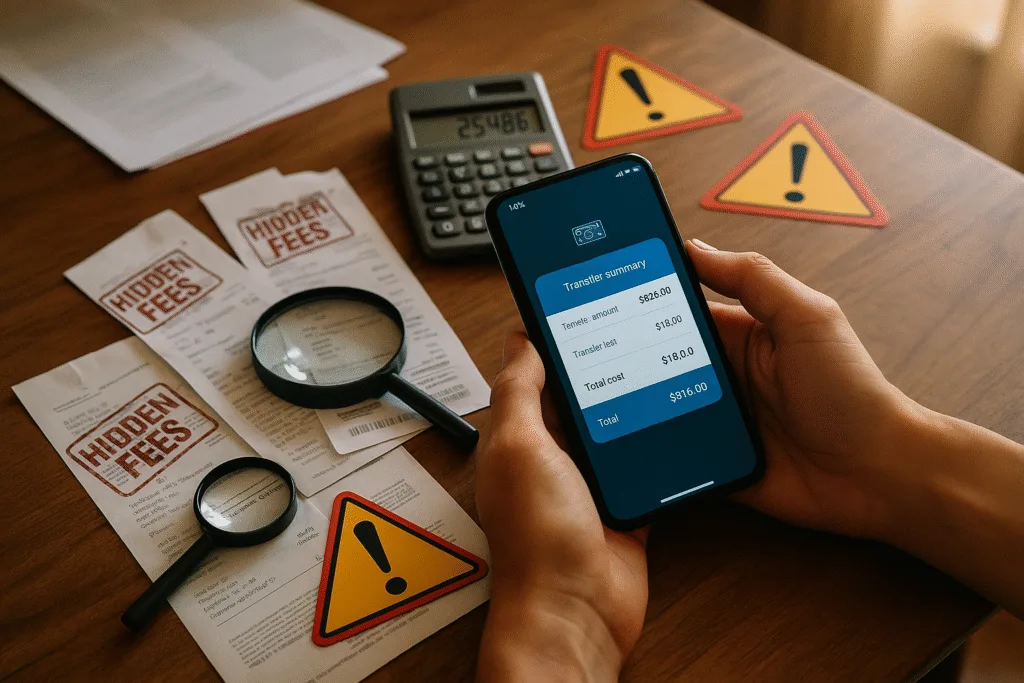
The Real Cost of “Free” Money Transfers
Let me break down what a “free” $1,000 transfer to Brazil actually costs you with different services:
Traditional Bank “Free” Transfer
Advertised cost: $0 transfer fee Real cost breakdown:
- Exchange rate markup (4%): $40
- Correspondent bank fee: $15 (surprise!)
- Receiving bank fee: $10 (charged to your family) Total hidden cost: $65
Online Service “No Fee” Transfer
Advertised cost: $0 transfer fee Real cost breakdown:
- Exchange rate markup (2.5%): $25
- Payment processing fee: $3.99
- Weekend rate adjustment: $8 Total hidden cost: $37
The honest services like Wise show you everything upfront: $8.50 total cost with mid-market exchange rate. No surprises, no hidden fees.
How to Spot Hidden Fees Before You Send Money
I’ve learned to be a detective when it comes to transfer fees. Here’s what I always check:
The Exchange Rate Test
Step 1: Look up the current USD/BRL rate on Google or XE.com Step 2: Compare it to what your transfer service is offering Step 3: Calculate the difference on your transfer amount
Example: If Google shows 5.20 BRL per dollar but your service offers 4.95, you’re losing 0.25 BRL per dollar. On $1,000, that’s $48 hidden in the exchange rate.
Questions to Ask Before Every Transfer
“What’s the total cost of my transfer?” Don’t let them just tell you the transfer fee.
“Are there any correspondent bank fees?” Hidden fees in international wire transfers can add up quickly, increasing business costs – make them spell out every possible charge.
“Will my recipient be charged anything?” You don’t want your family surprised by fees on their end.
“What exchange rate are you using?” Compare it to the mid-market rate immediately.
“Are there weekend or holiday surcharges?” Many services add 0.5-1% for weekend transfers.
Red Flags That Scream “Hidden Fees Ahead”
Vague pricing: “Competitive rates” or “low fees” without specific numbers Promotional rates: “0% fees for first transfer” often means terrible exchange rates Pressure tactics: “Limited time offer” or “Sign up now for special rates” Complex fee structures: If you need a calculator to understand their pricing, run No upfront total: Any service that won’t show you the total cost before you commit
The 5 Most Transparent Money Transfer Services
After years of getting burned, I’ve found services that actually tell you the truth about fees upfront.
#1 Wise: The Gold Standard for Transparency
Wise shows you exactly what you’ll pay before you send a penny. The total cost of a transfer is the fee plus exchange rate. If your provider says there’s no fee, check their exchange rate against the one Wise offers.
What I love: Real-time calculator shows exact fees and exchange rates. No surprises ever.
For $1,000 to Brazil: $8.50 total cost (0.85%). Period. That’s it.
#2 Remitly: Honest About Speed vs Cost
Remitly gives you two clear options: Economy (cheaper) or Express (faster). Both show total costs upfront.
Economy: $3.99 fee + small exchange rate markup = ~$15 total Express: $8.99 fee + slightly higher markup = ~$25 total for 15-minute delivery
#3 XE Money: No Transfer Fees, Fair Exchange Rates
XE, the cheapest option, has a US Dollar/Brazilian Real exchange rate of 5.5089 and a fee of 30.18 USD – but they’re transparent about their rates being their main revenue source.
What you get: Zero transfer fees, exchange rate markup clearly shown
#4 OFX: Upfront About Exchange Rate Markups
OFX doesn’t charge transfer fees regardless of how much gets sent. Its exchange rate markups tend to be around 1.35% to 4.50% – and they tell you this upfront.
Best for: Large transfers where their percentage-based model works better
#5 MoneyGram: Clear Pricing, Multiple Options
MoneyGram shows you exact fees and delivery times for each option. No guessing games.
Bank deposit: $4.99 fee + 1-2% exchange markup Cash pickup: $8.99 fee + 2-3% exchange markup
Smart Strategies to Avoid Hidden Transfer Fees
Here are the tactics I use to keep every penny where it belongs:
The Total Cost Comparison Method
Never compare just transfer fees. Always calculate: Total Cost = Transfer Fee + (Amount × Exchange Rate Difference)
Example calculation:
- Service A: $5 fee + 2% exchange markup = $25 total on $1,000
- Service B: $0 fee + 3% exchange markup = $30 total on $1,000 Service A is actually cheaper despite the “fee.”
The Screenshot Strategy
Before confirming any transfer, I screenshot:
- The total cost breakdown
- The exchange rate being used
- The delivery timeline
- Any terms and conditions
This saved me when a service tried to add a “security fee” that wasn’t mentioned originally.
The Small Test Transfer Trick
Before sending large amounts with a new service, I send $50-100 first. I track:
- Exact amount deducted from my account
- Exact amount my recipient receives
- Any surprise fees that appear
- How long it actually takes
If the math doesn’t match their promises, I don’t send more.
Timing Your Transfers to Minimize Fees
Weekdays vs. Weekends: Many services add weekend spreads. Sending on Tuesday-Thursday often gets better rates.
Market Hours: Transfer during business hours in both countries when possible. After-hours often means worse rates.
Monthly Timing: Some services offer promotional rates at month-end to hit targets.
Advanced Fee Avoidance Techniques
Once you master the basics, these advanced strategies can save you even more:
The Multi-Platform Approach
I maintain accounts with 3-4 different services and compare costs for each transfer. Sometimes Wise is cheapest, sometimes Remitly. It takes 2 minutes to check and saves me $10-20 per transfer.
The Bank Account vs. Card Strategy
Bank transfers: Usually cheaper fees but slower Debit cards: Faster but often 1-2% extra cost Credit cards: Fastest but can add 3-4% in cash advance fees
I use bank transfers for regular monthly sends and cards only for emergencies.
The Currency Timing Strategy
Exchange rates fluctuate constantly. I set rate alerts on XE.com and transfer when rates are favorable. A 0.10 difference in USD/BRL rate saves me $20 on a $1,000 transfer.
The Volume Consolidation Method
Instead of sending $200 five times a month (paying fees each time), I send $1,000 once. The fixed fees hurt less on larger amounts.
What to Do When You Get Hit with Hidden Fees
Even with all these precautions, sometimes you’ll still encounter surprise fees. Here’s how to fight back:
Document Everything
Keep records of:
- Original fee quotes
- Screenshots of terms
- Email confirmations
- Bank statements showing actual charges
Contact Customer Service Immediately
Most legitimate companies will reverse fees if you can show they weren’t properly disclosed. Be polite but firm: “This fee wasn’t mentioned in your quote.”
Dispute with Your Bank
If you paid with a credit card, dispute the charge if fees weren’t properly disclosed. Banks often side with customers on hidden fee disputes.
Report to Regulators
For US-based services, file complaints with:
- CFPB (Consumer Financial Protection Bureau)
- FTC (Federal Trade Commission)
- State banking regulators
These agencies track complaint patterns and can force changes.
Share Your Experience
Post honest reviews on Google, Trustpilot, and social media. Companies hate bad reviews and often reach out to resolve issues when they go public.
Red Flag Companies and Services to Avoid
Through trial and error (mostly error), I’ve learned to avoid certain types of services:
The “Too Good to Be True” Services
If someone’s offering rates significantly better than everyone else, they’re making money somewhere. Usually through hidden fees or terrible customer service when things go wrong.
Services Without Proper Licensing
Always verify your transfer company is licensed:
- US: Registered as Money Services Business (MSB) with FinCEN
- State licenses: Check your state’s banking department website
- International: Regulated in their home country
Companies with Vague Fee Structures
If their website doesn’t clearly show fees and exchange rates, don’t trust them with your money.
Services That Require Large Upfront Deposits
Legitimate transfer services let you send money as you go. Anyone asking for large deposits upfront is usually a scam.
The Ultimate Fee Avoidance Checklist
Before every transfer, I run through this checklist:
✓ Checked the mid-market exchange rate on Google/XE ✓ Compared total costs from 3+ services ✓ Verified there are no recipient fees ✓ Confirmed no weekend/holiday surcharges apply ✓ Screenshotted the fee breakdown ✓ Checked if timing the transfer differently would save money ✓ Verified the service is properly licensed
Building Long-Term Relationships with Honest Services
Once you find services that avoid hidden transfer fees, stick with them. Many offer loyalty perks:
Wise: No fees get cheaper with higher volume tiers Remitly: Loyalty discounts for regular users MoneyGram: VIP programs for frequent senders
But always stay vigilant. Companies change fee structures, get acquired, or start adding new charges. I review my go-to services every 6 months to make sure they’re still competitive.
Teaching Your Family to Avoid Hidden Fees Too
I’ve taught my family in Brazil how to avoid fees on their end:
Receiving money: Use banks that don’t charge receiving fees Converting currency: Avoid airport exchanges and tourist areas Withdrawing cash: Know which ATMs don’t charge international fees
When your whole family knows how to avoid hidden transfer fees, you maximize every dollar sent.
The bottom line? The best approach is to use payment platforms or financial services that provide full cost transparency before a transaction. Don’t let banks and shady transfer services steal your hard-earned money through hidden fees.
Ready to stop getting ripped off? Start with Wise or Remitly for your next transfer – both show you exactly what you’ll pay upfront. Your wallet will thank you, and you’ll never have to worry about surprise fees again.
Have you been hit with hidden transfer fees before? Share your story in the comments below and help others avoid the same traps. Together, we can make the money transfer industry more honest and transparent.

My name is CAPRA CHRINO, and I am an enthusiast of the online universe. Since a very young age, I have been fascinated by the way the internet connects people, ideas, and opportunities.